
Beauty, blades, and a whole lot of déjà vu.
After years of fan requests and teases, Ubisoft has finally delivered a mainline Assassin’s Creed set in feudal Japan. Assassin’s Creed: Shadows brings the sprawling, open-world stealth-action RPG formula to a land of cherry blossoms, samurai code, and political intrigue. It’s a visually stunning adventure with high points that shine—especially in its stealth mechanics—but it also falls into some familiar Ubisoft patterns that may test your patience over time.
First off, the game is gorgeous. Shadows is easily one of the best-looking entries in the franchise to date. Whether you’re standing atop a misty mountain temple at sunrise or slipping through a lantern-lit village at midnight, the attention to detail is staggering. Dynamic weather and lighting effects add even more immersion—rain glistens off rooftops, fog rolls in across valleys, and the world feels alive in a way that makes exploration a joy, at least for the first few dozen hours.
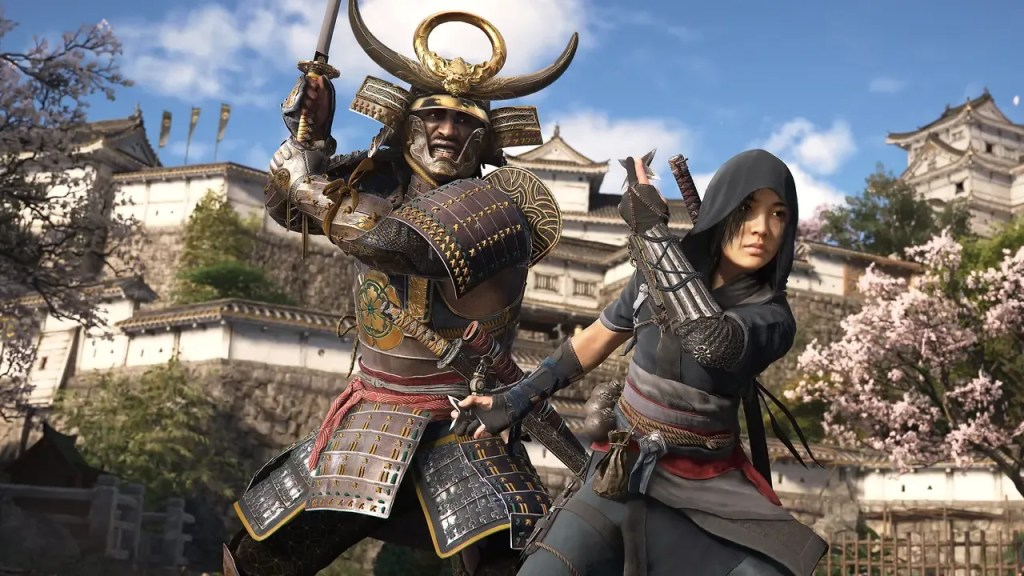
The dual protagonist setup—one a shinobi, the other a samurai—adds variety in theory, but in practice, I found myself gravitating toward the stealthier of the two. That’s partly because infiltrating enemy strongholds is far more satisfying than charging in sword-first. It’s even better once you tweak the settings: switching stealth kills to be instantaneous made a huge difference in the way I approached missions. Without that change, stealth often felt clunky, with enemies surviving assassination attempts or taking awkward amounts of time to go down. With it? The game finally clicked. I found myself meticulously planning my routes, picking off guards with a level of precision that felt true to the spirit of a shinobi assassin.
Combat, on the other hand, remains serviceable but unremarkable. If you’ve played Valhalla or Odyssey, you’ll be familiar with the mix of light/heavy attacks, dodges, parries, and special abilities. The samurai character adds a bit of flair with his brutal finishing moves, but fights can become repetitive quickly, especially once you’ve leveled up your gear and abilities.
Which brings me to the game’s biggest flaw: repetition. The first 8 to 10 hours of Shadows are engaging, packed with story beats, new mechanics, and world-building. But once you’ve settled into the gameplay loop—clear outposts, sync viewpoints, hunt bounties, repeat—it starts to feel formulaic. Ubisoft has built a massive world, but not enough meaningful variety to fill it. It’s the classic “Ubisoft fatigue” creeping in again, and it’s a shame because the setting deserves better.
That said, there are some standout moments. Story missions tend to be better designed and more tightly paced than the open-world side content, and there are a few stealth-heavy sequences that genuinely rival the best of Hitman or Splinter Cell. When Shadows leans into its strengths—careful infiltration, environmental storytelling, and player freedom—it’s at its best. Unfortunately, those moments are spaced out between a lot of familiar filler.
The RPG systems are back, with branching dialogue choices, skill trees, and crafting, though none of it feels particularly deep. The gear grind can be satisfying if you’re into that sort of thing, but it’s largely optional outside of higher difficulty levels.
In the end, Assassin’s Creed: Shadows is a visually stunning, mechanically sound addition to the franchise that’s held back by its own bloat. It gives players the Japanese setting they’ve long craved, and when it hits its stride, it’s a thrilling, immersive experience. But it also can’t fully escape the franchise’s repetitive tendencies.
If you’re a fan of stealth, the right settings can make this one sing. Just be prepared for a bit of déjà vu along the way.
83%
 stillgotgame.org
Leave a comment